If you’ve searched for WooCommerce vs Shopify, you already know the internet is flooded with generic advice. Most articles pick a winner without understanding your business. This guide is different.
We’ve analyzed real-world data, migration case studies, 2026 pricing structures, AI commerce trends, and SEO performance across both platforms — so you can make a decision you won’t regret six months from now.
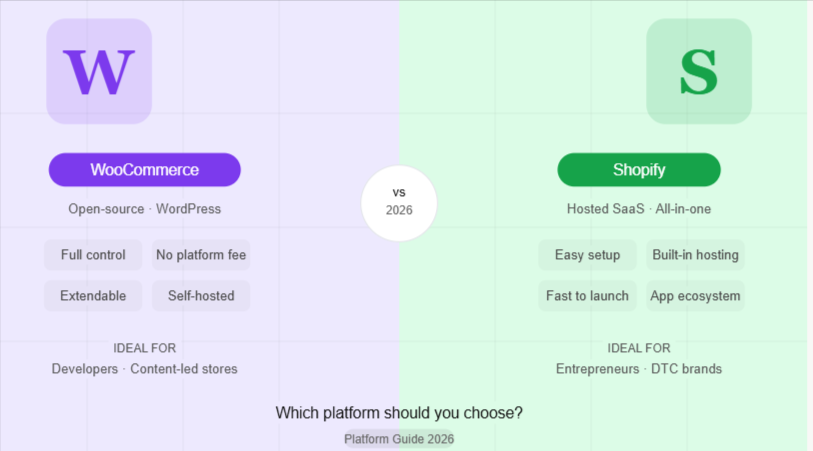
The short answer: WooCommerce wins for content-led SEO, deep customization, and cost control at scale. Shopify wins for fast launches, low maintenance, and AI-native commerce in 2026. Neither is universally better — the right platform depends entirely on your business model.
✅ Choose WooCommerce if…
- You already use WordPress
- SEO and content marketing is core to your strategy
- You need deep customization or own your data
- You’re a high-volume seller wanting lower fees
- You have developer resources
- You want zero vendor lock-in
🔵 Choose Shopify if…
- You want to launch fast without technical hassle
- You want AI-native commerce (ChatGPT, Perplexity)
- You prefer predictable monthly costs
- You need automatic scaling on high-traffic days
- You’re a non-technical founder or DTC brand
- Speed-to-market matters more than control
1. What Are WooCommerce and Shopify?
WooCommerce — Open-Source Freedom
WooCommerce is a free, open-source eCommerce plugin for WordPress. Because WordPress powers 43% of all websites globally, WooCommerce has grown into the most widely installed eCommerce solution in the world — running on approximately 28% of all online stores in 2026, with projected growth to 32% by 2028.
Key characteristics: Self-hosted, open-source, 100% code ownership, infinite customization, zero platform transaction fees, and requires developer involvement for advanced setups.
Shopify — Hosted Simplicity
Shopify is a fully hosted SaaS (Software as a Service) eCommerce platform. You pay a monthly subscription and Shopify handles hosting, security, infrastructure, and updates. It powers 15% of the top 1 million highest-traffic stores globally in 2026 — more than WooCommerce’s 9.6% in that same high-traffic tier.
Key characteristics: Fully managed, subscription-based, predictable costs, fast setup, automatic scaling, AI-native commerce integrations, and limited deep customization.
2. WooCommerce vs Shopify: Pricing & True Cost of Ownership
Platform pricing is the most misunderstood comparison. The headline cost tells you almost nothing. What matters is Total Cost of Ownership (TCO) over 2–3 years.
💜 WooCommerce Costs
| Plugin itself | FREE |
| Managed hosting | $30–$100/mo |
| Premium theme | $50–$350 one-time |
| Premium extensions | $0–$200/mo |
| Developer maintenance | $75–$150/hr |
| Payment gateway fee | 1.4%–2.9% (no platform fee) |
🔵 Shopify Plans (2026)
| Basic | $39/mo + 2% ext. fee |
| Shopify | $105/mo + 1% ext. fee |
| Advanced | $399/mo + 0.5% ext. fee |
| Shopify Plus | From $2,300/mo |
| Essential apps | $50–$200+/mo |
| Payment fee (Shopify Pay) | 0% if using Shopify Payments |
3. WooCommerce vs Shopify: Full Feature Comparison
Here’s a complete side-by-side breakdown across every major dimension — from setup to AI commerce.
| Feature | WooCommerce | Shopify |
|---|---|---|
| Setup time | Hours to days (hosting + WordPress setup) | Minutes to hours (guided wizard) |
| Monthly cost | $30–$300+ (flexible) | $39–$399+ (fixed tiers + apps) |
| Transaction fees | 0% platform fee — gateway fees only | 0.5%–2% on external gateways |
| Hosting | Self-managed (you choose) | Fully managed by Shopify |
| Customization | Unlimited — full code access | Limited by platform constraints |
| SEO control | Full control — URLs, schema, robots.txt | Basic built-in, rigid URL structure |
| Blogging / Content | Best-in-class (WordPress CMS) | Basic blog, no categories |
| Page speed (median LCP) | 3.4s mobile (host-dependent) | 2.1s mobile (global CDN) |
| Security | Self-managed — your responsibility | Fully managed, PCI compliant, SSL |
| Scalability | Manual (hosting upgrade needed) | Automatic — unlimited pageviews |
| AI commerce (2026) | Not natively supported | ChatGPT + Perplexity native ✅ |
| Plugin / App library | 59,000+ WordPress plugins | 8,000+ curated apps |
| Payment gateways | 100+ gateways, no restrictions | Shopify Payments preferred; fees for third-party |
| Data ownership | 100% — your data, your server | Hosted by Shopify |
| Support | Community + paid developer support | 24/7 live chat, phone, email |
| POS | Third-party required | Shopify POS — built-in hardware + software |
| Best for | Developers, content brands, high-volume | Beginners, DTC brands, fast-growth merchants |
4. WooCommerce vs Shopify: SEO Performance
This is where the two platforms diverge most sharply — and where WooCommerce holds its strongest competitive advantage in 2026.
WooCommerce SEO Strengths
- Full control over URL structure — clean, keyword-rich URLs with no forced prefixes
- Deep schema markup control via Rank Math or Yoast SEO — product, review, breadcrumb, FAQ schema
- Complete access to robots.txt and sitemap configuration
- WordPress’s blogging engine — the world’s most SEO-mature CMS with categories, tags, internal linking
- WooCommerce stores rank for 34% more organic keywords on average vs Shopify stores in the same niche (Ahrefs 2026)
- 3–5x content management productivity advantage for stores publishing 20+ articles per month
Shopify SEO Strengths
- Built-in CDN (Cloudflare, 300+ edge locations) — median LCP of 2.1s mobile vs WooCommerce’s 3.4s
- Automatic image optimization — WebP/AVIF conversion and lazy loading by default (2026 update)
- Built-in SSL, HTTPS, and mobile-responsive themes — zero configuration needed
- Agentic Storefronts — products discoverable inside ChatGPT and Perplexity without extra optimization
Shopify SEO Limitations
- Rigid URL structure — /products/ and /collections/ prefixes cannot be removed
- Limited robots.txt control — restricts how search engines crawl your site
- Duplicate content risk — multiple URLs for product variants
- Basic blogging — no categories, limited template control, poor for content-heavy SEO strategies
5. WooCommerce vs Shopify: Speed & Performance
Page speed is a confirmed Google ranking factor and a direct driver of conversions. A 1-second delay in mobile load time reduces conversions by up to 20%.
🔵 Shopify Performance
- Median LCP (mobile): 2.1 seconds
- Median LCP (desktop): 1.4 seconds
- Median page transfer: 2.8 MB
- 300+ global CDN edge locations
- Auto-scaling — no Black Friday risk
- WebP/AVIF image optimization (2026)
💜 WooCommerce Performance
- Median page transfer: 3.4 MB (unoptimized)
- Potential LCP: sub-2s on premium managed hosting
- HPOS reduces order query times by 60–80%
- Requires manual CDN + caching configuration
- Manual scaling — hosting upgrade for traffic spikes
- Best with WP Rocket + Cloudflare combo
6. The 2026 Differentiator: AI-Native Commerce
This is the most important new factor in the WooCommerce vs Shopify debate in 2026 — and it decisively favors Shopify.
Shopify is a founding partner of OpenAI’s commerce infrastructure. Through native ACP integration via Stripe, Shopify merchants can make their products discoverable and purchasable directly inside ChatGPT. A shopper can ask ChatGPT for a product recommendation, see your listing, and complete a purchase without leaving the conversation.
Shopify products also appear in Google AI Overviews and Perplexity recommendation carousels without any additional optimization from the merchant — a direct result of how Shopify structures product schema by default.
WooCommerce and AI Commerce
WooCommerce can reach AI-native discovery through proper schema markup and structured data, but there is no native ChatGPT commerce integration. This requires custom engineering most stores haven’t done yet.
7. WooCommerce vs Shopify: Scalability
Shopify Scalability
Shopify’s infrastructure scales automatically. All plans include unlimited pageviews and visitors — a small store on Basic can handle massive Black Friday traffic without any configuration. Shopify Plus serves enterprise clients including Allbirds, Gymshark, and Heinz.
WooCommerce Scalability
WooCommerce scales with your hosting. At enterprise level (AWS, GCP, dedicated servers), it handles 10,000+ concurrent users — but costs $500–$2,000/month in hosting plus DevOps. WooCommerce’s High-Performance Order Storage (HPOS), now default in WooCommerce 9.x, reduces order query times by 60–80%.
8. Migrating Between WooCommerce and Shopify
Migration is fully possible in both directions — but get it wrong and you risk losing organic rankings, revenue, and customer data.
WooCommerce → Shopify
- Export products, customers, and orders via WooCommerce export tools
- Use Shopify’s Store Importer app for automated migration
- Set up 301 redirects for every old URL
- Rebuild integrations — not all WooCommerce plugins have Shopify equivalents
- Expect 2–4 weeks for a mid-size store
Shopify → WooCommerce
- Export data via Shopify’s built-in export or Cart2Cart migration service
- Set up WordPress + WooCommerce with your chosen host first
- Implement 301 redirects — /products/ and /collections/ must map to WooCommerce URLs
- Rebuild apps and integrations via WooCommerce plugins
- Thoroughly test checkout, payment gateways, and tax settings before launch
9. WooCommerce vs Shopify: Who Should Choose What?
✅ WooCommerce is ideal for:
- WordPress users adding a store to an existing site
- Content-led businesses (blogs + eCommerce)
- High-volume stores processing $50K+/month
- Businesses with strict data sovereignty needs
- Developers and agencies building custom stores
- Businesses wanting to avoid vendor lock-in
🔵 Shopify is ideal for:
- New merchants wanting to launch in days, not weeks
- DTC brands past $10K/month needing reliability
- Non-technical founders focused on marketing
- Brands targeting AI-native discovery (ChatGPT)
- Teams without a dedicated developer
- Stores prioritizing speed-to-market over control
10. Frequently Asked Questions
Is WooCommerce better than Shopify for SEO?
Yes, for long-term content-driven SEO strategies, WooCommerce is the stronger platform. It gives you full control over URL structure, schema markup, robots.txt, and content management through WordPress. WooCommerce stores rank for 34% more organic keywords on average compared to Shopify in the same niche (Ahrefs 2026).
Is Shopify cheaper than WooCommerce?
Not necessarily. While Shopify’s monthly subscription is predictable, transaction fees (0.5%–2%) and essential apps ($50–$200+/month) can push total costs well above a managed WooCommerce setup. High-volume stores almost always pay less with WooCommerce’s zero platform transaction fees.
Can I migrate from Shopify to WooCommerce?
Yes — both directions are possible. The critical step is setting up 301 redirects for every changed URL before launch. Failing to do so is the most common cause of post-migration ranking drops. Allow 2–6 weeks for a typical mid-size store migration.
Which is easier to use: WooCommerce or Shopify?
Shopify is significantly easier for non-technical users. Its guided setup, drag-and-drop builder, and managed infrastructure mean most founders can have products live without touching code. WooCommerce requires WordPress setup, hosting configuration, and plugin management — it rewards technical users with far greater flexibility.
Does WooCommerce work with ChatGPT in 2026?
Not natively. Shopify is a founding partner of OpenAI’s commerce infrastructure, enabling merchants to sell directly inside ChatGPT conversations. WooCommerce can achieve AI-native discoverability through proper schema markup and structured data, but there is no equivalent native integration — this is Shopify’s clearest competitive advantage in 2026.
Final Verdict: WooCommerce vs Shopify in 2026
Neither platform is universally better. The right choice depends on what your business actually needs — not what works for someone else’s store.
Choose WooCommerce if you care about SEO dominance, full customization, data ownership, and long-term cost efficiency at scale. It is the platform of choice for ambitious, content-led brands that refuse to be constrained by platform limits.
Choose Shopify if you value launching fast, managing less, and positioning yourself at the frontier of AI-native commerce. In 2026, Shopify’s ChatGPT integration alone is a compelling reason for product-first brands who want to be discoverable inside AI conversations.
The market data reflects this split. More stores overall are on WooCommerce — but more high-revenue, high-traffic stores are on Shopify. Your success ultimately depends far more on your products, your marketing, and your customer experience than on which platform you pick.